Bell states
A Bell state is the simplest example of quantum entanglement - a two-qubit state where measuring one qubit instantly determines the outcome of the other. There are four of them, and all four are built from the same two gates: a Hadamard to create superposition, followed by a CNOT to entangle the qubits. An X gate or two placed in front steers the circuit to one specific Bell state out of the four.
They are worth knowing well: Superdense coding and Quantum teleportation both begin by sharing a Bell state between two parties.
The four states
Throughout this page the left digit is q[0] and the right digit is q[1].
- \( |\Phi^+\rangle = \dfrac{|00\rangle + |11\rangle}{\sqrt{2}} \) - the qubits always agree
- \( |\Phi^-\rangle = \dfrac{|00\rangle - |11\rangle}{\sqrt{2}} \) - agree, with a relative minus sign
- \( |\Psi^+\rangle = \dfrac{|01\rangle + |10\rangle}{\sqrt{2}} \) - the qubits always disagree
- \( |\Psi^-\rangle = \dfrac{|01\rangle - |10\rangle}{\sqrt{2}} \) - disagree, with a relative minus sign
How to read the notation
\( |00\rangle \) is "ket" notation for "both qubits read 0". The number in front of each ket is its amplitude, and squaring an amplitude gives the probability of measuring that outcome. In \( |\Phi^+\rangle \), each amplitude is \( \tfrac{1}{\sqrt{2}} \approx 0.707 \), so each outcome has probability \( 0.707^2 = 50\% \), and the two probabilities sum to 1. The minus sign in \( |\Phi^-\rangle \) and \( |\Psi^-\rangle \) is a relative phase: it doesn't change the measurement probabilities on its own, but it makes the state behave differently once more gates act on it, which is exactly what protocols like superdense coding exploit.
Step by step: building \( |\Phi^+\rangle \)
- Both qubits start at \( |0\rangle \), so the joint state is \( |00\rangle \).
- H on
q[0]puts the first qubit in an equal superposition: \( \tfrac{1}{\sqrt{2}}(|00\rangle + |10\rangle) \).q[0]is now 0 and 1 at once;q[1]is untouched. - CNOT (control
q[0], targetq[1]) flipsq[1]only in the part of the state whereq[0]is 1: \( \tfrac{1}{\sqrt{2}}(|00\rangle + |11\rangle) \).
That final state is \( |\Phi^+\rangle \). Neither qubit has a definite value on its own, but the two are now guaranteed to match when measured - that guarantee is the entanglement.
One recipe, four states
The other three Bell states use the exact same H + CNOT core. The only difference is an X gate (a bit flip) on one or both qubits before the core, which changes what state the recipe starts from and therefore where it ends up.
See Build your circuit with code for why parentheses in the Qiskit and Cirq code below can look a little square in this site's code font.
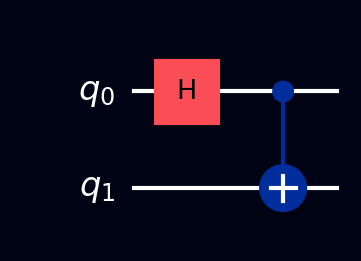
Just H then CNOT, the base pattern, as derived step by step above.
\( \tfrac{1}{\sqrt{2}}(|00\rangle + |11\rangle) \)
OPENQASM 2.0;
include "qelib1.inc";

qreg q[3];
creg c[3];

h q[0];
cx q[0], q[1];
OPENQASM 3.0;
include "stdgates.inc";

qubit[3] q;
bit[3] c;

h q[0];
cx q[0], q[1];
from qiskit import QuantumRegister, ClassicalRegister, QuantumCircuit
from numpy import pi

qreg_q = QuantumRegister(3, 'q')
creg_c = ClassicalRegister(3, 'c')
circuit = QuantumCircuit(qreg_q, creg_c)

circuit.h(qreg_q[0])
circuit.cx(qreg_q[0], qreg_q[1])
import cirq
import math

q = cirq.LineQubit.range(3)
circuit = cirq.Circuit()
circuit.append(cirq.H(q[0]))
circuit.append(cirq.CNOT(q[0], q[1]))
print(circuit)
namespace QompileCircuit {
    open Microsoft.Quantum.Canon;
    open Microsoft.Quantum.Intrinsic;
    open Microsoft.Quantum.Math;
    open Microsoft.Quantum.Convert;

    operation Circuit() : Result[] {
        use q = Qubit[3];
        mutable c = [Zero, size = 3];

        H(q[0]);
        CNOT(q[0], q[1]);

        ResetAll(q);
        return c;
    }
}
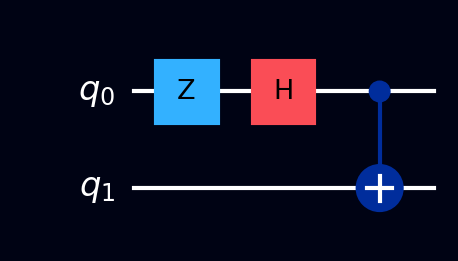
An X on q[0] before the core flips q[0] to \( |1\rangle \) first. H acting on \( |1\rangle \) produces \( \tfrac{1}{\sqrt{2}}(|0\rangle - |1\rangle) \) instead of a plus, and that minus sign carries through the CNOT.
\( \tfrac{1}{\sqrt{2}}(|00\rangle - |11\rangle) \)
OPENQASM 2.0;
include "qelib1.inc";

qreg q[3];
creg c[3];

x q[0];
h q[0];
cx q[0], q[1];
OPENQASM 3.0;
include "stdgates.inc";

qubit[3] q;
bit[3] c;

x q[0];
h q[0];
cx q[0], q[1];
from qiskit import QuantumRegister, ClassicalRegister, QuantumCircuit
from numpy import pi

qreg_q = QuantumRegister(3, 'q')
creg_c = ClassicalRegister(3, 'c')
circuit = QuantumCircuit(qreg_q, creg_c)

circuit.x(qreg_q[0])
circuit.h(qreg_q[0])
circuit.cx(qreg_q[0], qreg_q[1])
import cirq
import math

q = cirq.LineQubit.range(3)
circuit = cirq.Circuit()
circuit.append(cirq.X(q[0]))
circuit.append(cirq.H(q[0]))
circuit.append(cirq.CNOT(q[0], q[1]))
print(circuit)
namespace QompileCircuit {
    open Microsoft.Quantum.Canon;
    open Microsoft.Quantum.Intrinsic;
    open Microsoft.Quantum.Math;
    open Microsoft.Quantum.Convert;

    operation Circuit() : Result[] {
        use q = Qubit[3];
        mutable c = [Zero, size = 3];

        X(q[0]);
        H(q[0]);
        CNOT(q[0], q[1]);

        ResetAll(q);
        return c;
    }
}
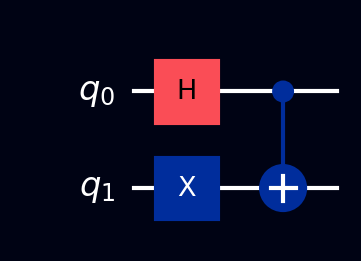
An X on q[1] before the core starts the pair at \( |01\rangle \) instead of \( |00\rangle \), so the CNOT ends up correlating opposite values: the outcomes become 01 and 10 instead of 00 and 11.
\( \tfrac{1}{\sqrt{2}}(|01\rangle + |10\rangle) \)
OPENQASM 2.0;
include "qelib1.inc";

qreg q[3];
creg c[3];

x q[1];
h q[0];
cx q[0], q[1];
OPENQASM 3.0;
include "stdgates.inc";

qubit[3] q;
bit[3] c;

x q[1];
h q[0];
cx q[0], q[1];
from qiskit import QuantumRegister, ClassicalRegister, QuantumCircuit
from numpy import pi

qreg_q = QuantumRegister(3, 'q')
creg_c = ClassicalRegister(3, 'c')
circuit = QuantumCircuit(qreg_q, creg_c)

circuit.x(qreg_q[1])
circuit.h(qreg_q[0])
circuit.cx(qreg_q[0], qreg_q[1])
import cirq
import math

q = cirq.LineQubit.range(3)
circuit = cirq.Circuit()
circuit.append(cirq.X(q[1]))
circuit.append(cirq.H(q[0]))
circuit.append(cirq.CNOT(q[0], q[1]))
print(circuit)
namespace QompileCircuit {
    open Microsoft.Quantum.Canon;
    open Microsoft.Quantum.Intrinsic;
    open Microsoft.Quantum.Math;
    open Microsoft.Quantum.Convert;

    operation Circuit() : Result[] {
        use q = Qubit[3];
        mutable c = [Zero, size = 3];

        X(q[1]);
        H(q[0]);
        CNOT(q[0], q[1]);

        ResetAll(q);
        return c;
    }
}
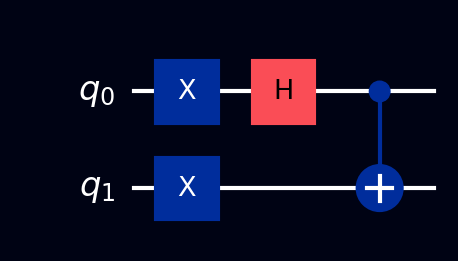
An X on both qubits combines the two effects: the pair starts at \( |11\rangle \), giving both the swapped correlation (01/10) and the minus sign.
\( \tfrac{1}{\sqrt{2}}(|01\rangle - |10\rangle) \)
OPENQASM 2.0;
include "qelib1.inc";

qreg q[3];
creg c[3];

x q[0];
x q[1];
h q[0];
cx q[0], q[1];
OPENQASM 3.0;
include "stdgates.inc";

qubit[3] q;
bit[3] c;

x q[0];
x q[1];
h q[0];
cx q[0], q[1];
from qiskit import QuantumRegister, ClassicalRegister, QuantumCircuit
from numpy import pi

qreg_q = QuantumRegister(3, 'q')
creg_c = ClassicalRegister(3, 'c')
circuit = QuantumCircuit(qreg_q, creg_c)

circuit.x(qreg_q[0])
circuit.x(qreg_q[1])
circuit.h(qreg_q[0])
circuit.cx(qreg_q[0], qreg_q[1])
import cirq
import math

q = cirq.LineQubit.range(3)
circuit = cirq.Circuit()
circuit.append(cirq.X(q[0]))
circuit.append(cirq.X(q[1]))
circuit.append(cirq.H(q[0]))
circuit.append(cirq.CNOT(q[0], q[1]))
print(circuit)
namespace QompileCircuit {
    open Microsoft.Quantum.Canon;
    open Microsoft.Quantum.Intrinsic;
    open Microsoft.Quantum.Math;
    open Microsoft.Quantum.Convert;

    operation Circuit() : Result[] {
        use q = Qubit[3];
        mutable c = [Zero, size = 3];

        X(q[0]);
        X(q[1]);
        H(q[0]);
        CNOT(q[0], q[1]);

        ResetAll(q);
        return c;
    }
}
What you'll see
All four Bell states look the same in the probability view and only reveal their differences in the phase-aware views:
- Probabilities - two equal bars at 50% each. For \( |\Phi^\pm\rangle \) the bars sit on
00and11; for \( |\Psi^\pm\rangle \) they sit on01and10. - Q-Sphere - two points, one per basis state in the superposition. For the minus states, the two points show different phase colors, which is how the Q-Sphere distinguishes \( |\Phi^+\rangle \) from \( |\Phi^-\rangle \).
- Statevector - two non-zero amplitudes of equal magnitude (≈0.707). For the minus states, one of the two amplitudes is negative.