√X¶
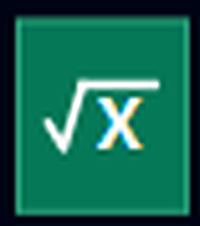
√X ("square root of X") is a gate that, applied twice, is exactly equal to one Pauli-X gate. It's a common native gate on real quantum hardware.
| Qubits | 1 |
| Parameters | None |
| Inverse | √X† (not self-inverse) |
| Also called | SX gate |
What it does¶
√X creates an equal superposition from either basis state, similar to H, but with a different pattern of complex phases. Applying it twice in a row reproduces a full bit-flip: \( (\sqrt{X})^2 = X \).
Matrix¶
\[
\sqrt{X} = \frac{1}{2}\begin{pmatrix} 1+i & 1-i \\ 1-i & 1+i \end{pmatrix}
\]
Action on basis states¶
- \( |0\rangle \rightarrow \dfrac{1}{2}\big[(1+i)|0\rangle + (1-i)|1\rangle\big] \)
- \( |1\rangle \rightarrow \dfrac{1}{2}\big[(1-i)|0\rangle + (1+i)|1\rangle\big] \)
Example¶
Two √X gates in a row on q[0] (starting at \( |0\rangle \)) land exactly on \( |1\rangle \) - the same result one X gate would give in a single step.
Other notations¶
Naming conventions across ecosystems; exact syntax can vary by library version, and this does not claim to be Qompile's generated output unless otherwise noted.
| Language | Typical form |
|---|---|
| OpenQASM 2.0 | sx q[0]; |
| Qiskit | circuit.sx[q[0]] |
| Cirq | cirq.X(q[0])**0.5 |
| Q# | - |
Related¶
- √X† - the inverse of √X
- Pauli-X / NOT - (√X)² = X