CNOT

CNOT ("controlled-NOT") is the most common two-qubit gate: it flips a target qubit, but only when a control qubit is \( |1\rangle \). It's the standard way to create entanglement between two qubits.
| Qubits | 2 (one control, one target) |
| Parameters | None |
| Inverse | Itself (CNOT² = I) |
| Also called | CX, controlled-X |
What it does
If the control qubit is \( |0\rangle \), CNOT does nothing. If the control is \( |1\rangle \), CNOT applies an X gate to the target. Applied to a control in superposition, this correlates the two qubits - the essence of entanglement.
Matrix
Action on basis states
(control first, target second)
- \( |00\rangle \rightarrow |00\rangle \)
- \( |01\rangle \rightarrow |01\rangle \)
- \( |10\rangle \rightarrow |11\rangle \)
- \( |11\rangle \rightarrow |10\rangle \)
Example
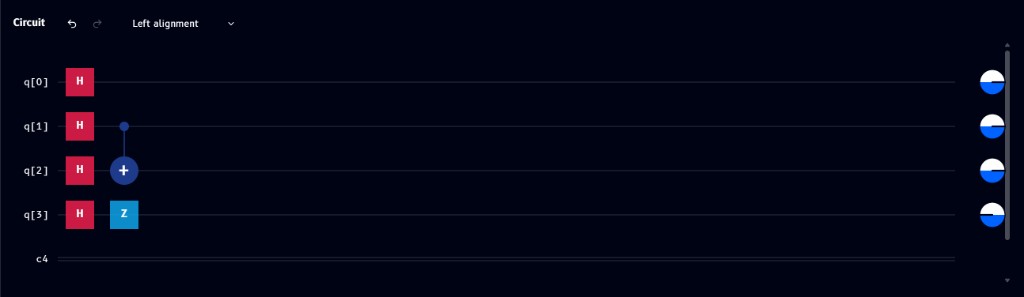
On the circuit canvas, CNOT is drawn as a solid dot on the control wire connected by a vertical line to a circled + on the target wire - see Multi-qubit gate symbols. H on q[0] followed by CNOT from q[0] to q[1] is the standard Bell state circuit:
Other notations
Naming conventions across ecosystems; exact syntax can vary by library version, and this does not claim to be Qompile's generated output unless otherwise noted.
| Language | Typical form |
|---|---|
| OpenQASM 2.0 | cx q[0], q[1]; |
| Qiskit | circuit.cx[q[0], q[1]] |
| Cirq | cirq.CNOT(q[0], q[1]) |
| Q# | CNOT(q[0], q[1]); |
Related
- Toffoli - the three-qubit generalization (two controls)
- Control - add a standalone control point to build custom controlled gates
- Bell states