Bernstein-Vazirani
Bernstein-Vazirani recovers a hidden bitstring in a single query to a function that a classical computer would have to call \( n \) separate times. It uses exactly the same circuit skeleton as Deutsch-Jozsa - if you've read that page, this one is a short and satisfying payoff.
Why this exists
The game: a mystery function hides a secret \( n \)-bit string \( s \). Given any input \( x \), the function returns the dot product mod 2 of the secret and your input:
In words: look at the positions where both \( s \) and \( x \) have a 1, count them, and return whether that count is odd (1) or even (0). Your job is to find \( s \).
Classically the best you can do is probe one bit at a time: query \( x = 100\ldots0 \) to learn \( s \)'s first bit, \( x = 010\ldots0 \) for the second, and so on - \( n \) queries, no shortcuts, because each query returns only one bit and \( s \) contains \( n \) bits of information.
Bernstein-Vazirani reads out the whole string in one query. It's a sharper demonstration than Deutsch-Jozsa: not just "which of two categories," but \( n \) full bits of hidden structure extracted at once. It's also the stepping stone to Simon's algorithm, where the gap over classical becomes exponential.
What you need to know first
Everything here was set up on the Deutsch-Jozsa page - read What an oracle is and Phase kickback first. The one extra ingredient:
- Dot product mod 2 - just XOR (addition mod 2) applied across the bit positions selected by \( s \). Khan Academy's XOR primer and modular arithmetic intro cover the background.
There's also a beautiful fact hiding in this algorithm, worth stating up front: applying a Hadamard to every qubit of a basis state \( |x\rangle \) produces
That is, the Hadamard layer converts bitstrings into phase patterns and back. Bernstein-Vazirani is a direct application: build the phase pattern of \( s \) using the oracle, then let the Hadamard layer convert it back into the bitstring \( s \).
How it works, step by step
Same skeleton as Deutsch-Jozsa: \( n \) input qubits plus one ancilla.
- Prepare the ancilla: X then H, putting it in \( |-\rangle \) so the oracle stamps phases (phase kickback).
- Superpose the inputs: H on every input qubit.
- One oracle call: every branch \( |x\rangle \) picks up the tag \( (-1)^{s \cdot x} \).
- Interfere: H on every input qubit again.
- Measure the input register: the result is \( s \) itself, every bit of it, with certainty.
The math
After step 3 the input register holds \( \frac{1}{\sqrt{2^n}} \sum_x (-1)^{s \cdot x} |x\rangle \). But compare that to the boxed identity above: this is exactly \( H^{\otimes n}|s\rangle \). And Hadamard is its own inverse (\( H^2 = I \)), so applying the final Hadamard layer simply undoes it:
The register lands on the basis state \( |s\rangle \) exactly - probability 1, no randomness. The oracle's phase pattern was the Hadamard transform of the secret, and the final layer inverts the transform.
A worked example
Take \( n = 3 \) and secret \( s = 101 \) (so \( s_0 = 1, s_1 = 0, s_2 = 1 \)). The oracle must XOR \( x_0 \oplus x_2 \) into the ancilla, which is just two CNOTs: one from q[0], one from q[2], both targeting the ancilla.
Follow one branch to see the tagging: input \( x = 110 \) (\( x_0 = 0, x_1 = 1, x_2 = 1 \)) has \( s \cdot x = (1\cdot0) \oplus (0\cdot1) \oplus (1\cdot1) = 1 \), so branch \( |110\rangle \) gets a minus sign. Do this for all eight branches and the sign pattern spells out the Hadamard transform of \( |101\rangle \); the final H layer collapses it back, and all 1024 shots read 101.
Notice what the oracle looks like structurally: one CNOT per 1-bit of the secret. The algorithm literally reads off which wires the CNOTs hang from - but it does so through the front door, with one function call, without peeking inside the box.
The circuit
For \( s = 101 \), build on 4 qubits (q[0]-q[2] inputs, q[3] ancilla), or load it from the Ready algorithms panel:
- X on
q[3], then H onq[3] - H on
q[0],q[1],q[2] - Oracle: CNOT
q[0]→q[3], CNOTq[2]→q[3] - H on
q[0],q[1],q[2] - Measure
q[0],q[1],q[2]
To hide a different secret, change which input qubits get a CNOT to the ancilla in step 3.
References for the circuit layout: Wikipedia: Bernstein-Vazirani algorithm and IBM Quantum Learning: Quantum query algorithms.
The circuit in code
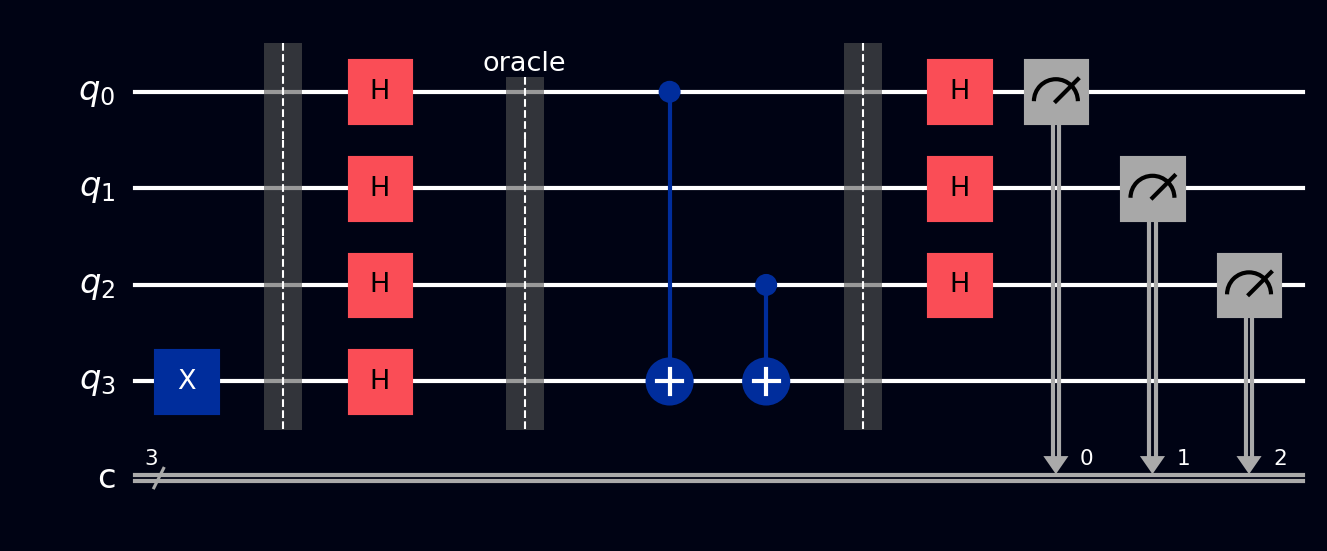
The \( s = 101 \) circuit (\( n = 3 \), 4 qubits). Barriers separate the three phases: ancilla + input setup, oracle, and interference + measurement.
OPENQASM 2.0;
include "qelib1.inc";

qreg q[4];
creg c[3];

// Ancilla into |->
x q[3];
h q[3];

// Superpose inputs
h q[0];
h q[1];
h q[2];
barrier q;

// Oracle: s = 101, one CNOT per 1-bit
cx q[0], q[3];
cx q[2], q[3];
barrier q;

// Interfere and measure inputs only
h q[0];
h q[1];
h q[2];
measure q[0] -> c[0];
measure q[1] -> c[1];
measure q[2] -> c[2];
OPENQASM 3.0;
include "stdgates.inc";

qubit[4] q;
bit[3] c;

// Ancilla into |->
x q[3];
h q[3];

// Superpose inputs
h q[0];
h q[1];
h q[2];
barrier q;

// Oracle: s = 101
cx q[0], q[3];
cx q[2], q[3];
barrier q;

// Interfere and measure inputs only
h q[0];
h q[1];
h q[2];
c[0] = measure q[0];
c[1] = measure q[1];
c[2] = measure q[2];
from qiskit import QuantumCircuit
from qiskit_aer import AerSimulator

s = "101"                  # change this to any bitstring
n = len(s)
qc = QuantumCircuit(n + 1, n)

# Phase-kickback setup: ancilla into |->
qc.x(n)
qc.h(n)

# All inputs in superposition
qc.h(range(n))
qc.barrier()

# Oracle: one CNOT per 1-bit of the secret.
# reversed(s) handles Qiskit's bit ordering (qubit 0 = rightmost char)
for i, bit in enumerate(reversed(s)):
    if bit == "1":
        qc.cx(i, n)
qc.barrier()

# Final Hadamards decode the phase pattern back to |s>
qc.h(range(n))
qc.measure(range(n), range(n))

# Output: {'101': 1024} — one query, every bit, every shot
counts = AerSimulator().run(qc, shots=1024).result().get_counts()
print(counts)
import cirq

q = cirq.LineQubit.range(4)

circuit = cirq.Circuit()
# Ancilla into |->
circuit.append(cirq.X(q[3]))
circuit.append(cirq.H(q[3]))

# Superpose inputs
circuit.append([cirq.H(q[i]) for i in range(3)])
circuit.append(cirq.ops.Moment())  # barrier

# Oracle: s = 101
circuit.append(cirq.CNOT(q[0], q[3]))
circuit.append(cirq.CNOT(q[2], q[3]))
circuit.append(cirq.ops.Moment())  # barrier

# Interfere and measure inputs only
circuit.append([cirq.H(q[i]) for i in range(3)])
circuit.append(cirq.measure(q[0], q[1], q[2], key='result'))
print(circuit)
namespace QompileCircuit {
    open Microsoft.Quantum.Canon;
    open Microsoft.Quantum.Intrinsic;

    operation Circuit() : Result[] {
        use q = Qubit[4];
        mutable c = [Zero, size = 3];

        // Ancilla into |->
        X(q[3]);
        H(q[3]);

        // Superpose inputs
        H(q[0]);
        H(q[1]);
        H(q[2]);

        // Oracle: s = 101
        CNOT(q[0], q[3]);
        CNOT(q[2], q[3]);

        // Interfere and measure inputs only
        H(q[0]);
        H(q[1]);
        H(q[2]);
        set c w/= 0 <- M(q[0]);
        set c w/= 1 <- M(q[1]);
        set c w/= 2 <- M(q[2]);

        ResetAll(q);
        return c;
    }
}
What you'll see
- Probabilities - a single bar at 100% sitting exactly on the secret string.
- Q-Sphere - pause after the oracle: all eight branches present with equal size, and the phase coloring spells out the \( (-1)^{s \cdot x} \) pattern; after the final Hadamards, one point on \( |s\rangle \).
- Statevector - after the oracle, amplitudes of equal magnitude with signs alternating in the secret's pattern; at the end, a single 1.0 amplitude on \( |s\rangle \).